Identity, delegation and intent.
BUYER-OWNED DECISION OBJECT · VERSION 8 · DATA-TRUTH GATED
EXPERIAN ESTABLISHES TRUST. FINALITY PROPOSES PROOF AFTER ACTION.
One workflow.
One disproof test.
One authoritative record.
Determine whether Finality clears every absolute safety gate and reaches a buyer-set 10× BUILD / PARTNER target at proving what actually occurred after a consequential action—without replacing Agent Trust, Agent Operating System, Ascend or any Experian system of control.
THIS SCOPE DECISION REQUIRESNo capitalNo source accessNo valuation viewNo transaction commitment
TRUTH BOUNDARY
No live Experian connector, partnership, certification, buyer acceptance, 10× result or capital authorization is claimed. The room provides a falsifiable protocol, cryptographic evidence structure and signer-ready decision path. Results become claims only after buyer-controlled testing and independent verification.
01 · THE THESIS
Trust the actor. Govern the decision. Prove the ending.
Experian’s public Agent Trust and Agent Operating System direction addresses identity, intent, governed data, decisioning and oversight. Finality’s proposed role begins downstream, where acceptance can be mistaken for completion.
Data, models, policy and human control.
Execution and acknowledgement.
Authoritative reconciliation, refusal and replay.
Absolute safety gates: zero false FINAL, zero bypass, zero critical findings; 100% contradiction, revocation and replayNO EXCEPTIONS.Lower-is-better measures: at least 10× versus BUILD / PARTNEROR STOP.
02 · EXPERIAN INVESTMENT LOGIC
Built to survive the questions Experian already asks.
Experian’s FY26 public reporting emphasizes strategic fit, diligence, integration discipline, technology and information-security risk—and rigorous debate of organic BUILD alternatives. This room turns those priorities into one controlled test.
PUBLIC-SOURCE ALIGNMENT · NOT EXPERIAN ENDORSEMENT
The buyer keeps every decisive lever: workflow, baseline, authoritative end state, hidden cases, evidence, reviewers, materiality threshold and stop rule.
Read Experian FY26 Annual Report ↗01BOUNDARY MUST HOLD
Strategic adjacency
Does Finality extend the stack without competing with it?The proposed boundary starts after a consequential action, where claimed completion must be reconciled to buyer-authoritative reality.
02HEAD-TO-HEAD OR STOP
Organic BUILD alternative
Is the capability better than building or partnering?Experian owns the baseline, materiality threshold and hidden cases. Finality advances only on measured, evidenced outperformance.
03NO AVERAGING AWAY FAILURE
Model + control risk
Can the system refuse a plausible but unsupported ending?False FINAL, contradiction, revoked authority, evidence tampering and material change are mandatory adverse tests—not demo exceptions.
04BOUNDED INTERFACES
Composable integration
Can it fit existing controls without a platform replacement?Finality consumes approved authority and evidence interfaces, returns a receipt, and leaves identity, decisioning, orchestration and systems of record with Experian.
05REVERSIBLE FIRST STEP
Diligence + capital discipline
Can Experian learn enough before protected access or funding?The SCOPE, frozen estate, provenance, clean build, security record and buyer-authored protocol all precede any later protected-access decision.
IMMEDIATE DECISIONOne buyer-selected workflow
→ONLY AFTER PROOFA reusable proof contract
→WORKFLOW BY WORKFLOWEarned expansion—not assumed scale
Experian reports more than 2,300 Ascend client solutions. That creates option value for a composable post-action proof layer, but no broader deployment is claimed or authorized until each workflow clears its own protocol.
03 · BUYER REVIEW MAP
Five owners. Five questions. One controlled route.
This map makes the room easy to forward across M&A, Product, Engineering, Security / Legal / IP and Finance / IC. The rubric measures content completeness—not Experian approval or a transaction prediction.
CONTENT-COMPLETENESS RUBRIC500 / 500
Each owner has a defined internal question, an authoritative room record, a next action and a phase-appropriate status. Open gates remain open by design.
01ROUTE NOW
Andrew / M&A + process
Can I route this safely to the right internal owners?ROOM RECORD
SCOPE sponsor brief, decision packet and named-owner request
NEXT OWNER ACTION
Confirm the Product / Strategy and Architecture / Engineering owners.
100 / 100 content coverage
02SELECT
Product / Strategy
Is there one consequential workflow where this adds beyond AOS?ROOM RECORD
Buyer-selected workflow, BUILD / PARTNER baseline, end state and materiality
NEXT OWNER ACTION
Choose one workflow and define the authoritative external end state.
100 / 100 content coverage
03REPRODUCE
Architecture / Engineering
Can it reproduce, integrate and fail safely?ROOM RECORD
Approved interfaces, clean build, replay, observability, rollback and hidden cases
NEXT OWNER ACTION
Freeze the interface boundary and own the adversarial test design.
100 / 100 content coverage
04DILIGENCE
Security / Legal / IP
Who owns the estate, and what becomes accessible at each gate?ROOM RECORD
Counterparty, title, provenance, frozen estate, security and legal controls
NEXT OWNER ACTION
Verify ownership, dependency, privacy, security and access conditions.
100 / 100 content coverage
05LATER GATE
Finance / Investment Committee
What risk-adjusted value supports each later stage?ROOM RECORD
Evidence-bound capital register, valuation, approvals and agreement hashes
NEXT OWNER ACTION
Review economics only after accepted evidence and separate governance gates.
100 / 100 content coverage
EVIDENCE ASSURANCE LADDER
The claim rises only with the evidence.
E3 is seller-controlled organization. E4 is buyer-controlled protocol definition. E5 is qualified independent assurance. E6 is sustained buyer-controlled production evidence.
Seller-controlled evidence
Finality organizes the estate, records provenance and seals hashes. This is the current claim ceiling—not independent assurance.
Buyer-controlled protocol
Experian authors the workflow, baseline, hidden cases, thresholds, reviewers and STOP rights. A protocol definition is not a performance result.
Qualified independent assurance
An independent verifier reproduces the clean build, security record and replayable evidence package against the buyer-owned protocol.
Buyer-controlled production evidence
Sustained live operation, monitoring, incident records and production replay demonstrate that the result persists beyond the evaluation run.
CURRENT EXPERIAN WHY-NOW BRIDGE
Trust the actor. Govern the decision. Prove the ending.
Experian’s public direction establishes the first two controls. Finality proposes a bounded downstream proof layer for the third—after the consequential action and before unsupported closure is allowed to stand.
Experian is extending identity and fraud expertise to verify the person and the AI agent acting on that person’s behalf.
The actor is bound before action.A trusted operating layer brings data, decisioning, governance, auditability and human oversight into composable agent workflows.
The decision is governed before action.Explainability, monitoring, policy enforcement and model-risk controls make high-impact automation reviewable.
The control record follows the decision.Experian reports that 31% of consumers have used AI to transact, but only 17% are comfortable relying on AI for financial-services decisions.
The outcome must be proven after action.04 · EXPERIAN → FINALITY
The complete consequential-action workflow.
Select each control point. Ownership crosses only after the authoritative state exists; Finality consumes Experian-approved authority and evidence—it never grants authority.
EXPERIAN + EXISTING SYSTEMS · CONTROL AUTHORITYPROPOSED FINALITY EXTENSION · POST-ACTION PROOF
Proposed downstream extension
Is the evidence sufficient and admissible?
Finality consumes only the authority and evidence interfaces Experian approves. It does not create authority.
CONTROL RECORDVersioned evidence envelope
INPUTApproved authority + evidence interfaces
REFUSALContradiction blocks unsupported FINAL
OUTPUTReceipt returns to existing Experian controls
NON-CLAIMNo orchestration or system-of-record replacement
05 · SYNTHETIC PROOF LAB
Try to make Finality lie.
This surface demonstrates proposed refusal and cryptographic binding. It is not a live integration, benchmark, certification or buyer acceptance test.
REFERENCE OUTCOME
UNCERTAIN_STOPContradictory sources
Approved sources disagree. Finality preserves the conflict and blocks unsupported closure.
- 01Authority valid
- 02Action accepted
- 03System A reports complete
- 04Authoritative source B reports open
input hash
7ae1382355e0…d1f73e61policy hash
31c642651d92…134bc5e0evidence hash
9040e4fb2bb9…74d78cf3result hash
de9a2b8bb99c…22489904binding hash
f70ab7c5fb00…2f27c3fd{
"receipt_type": "SYNTHETIC_REFERENCE_ONLY",
"receipt_id": "FR-SHA256-F70AB7C5FB006959B18A",
"workflow": "Fraud case disposition",
"scenario": "Contradictory sources",
"input": {
"schema_version": "1.0",
"workflow_key": "fraud",
"workflow": "Fraud case disposition",
"action_claim": "Block high-risk transaction and close the case",
"authoritative_end_state": "Buyer-authoritative disposition plus confirmed downstream intervention"
},
"policy": {
"policy_id": "EXP-PROPOSED-REFUSAL-V1",
"expected_status": "UNCERTAIN_STOP",
"no_false_final": true,
"contradiction_blocks_final": true,
"revoked_authority_blocks_final": true,
"hash_mismatch_blocks_final": true,
"material_change_reopens": true
},
"evidence": {
"source_class": "SYNTHETIC_REFERENCE_ONLY",
"authority_state": "VALID_AT_ACTION",
"evidence_item_count": 4,
"ordered_events": [
"Authority valid",
"Action accepted",
"System A reports complete",
"Authoritative source B reports open"
]
},
"result": {
"status": "UNCERTAIN_STOP",
"reason": "Approved sources disagree. Finality preserves the conflict and blocks unsupported closure.",
"reopen_condition": "Contradiction resolved under buyer policy"
},
"hashes": {
"algorithm": "SHA-256",
"input_hash": "7ae1382355e08bacecd93c5104a12be169627d28f9ce1d559c0d5890d1f73e61",
"policy_hash": "31c642651d92af66e4cd80ac0d19a99469eed69d24507d0e0293db5a134bc5e0",
"evidence_hash": "9040e4fb2bb97338d08ff414d5d03d1ce6cafce9516cc81083b14f6e74d78cf3",
"result_hash": "de9a2b8bb99cd50df3f3c2eab96c20cdb432c372006b4b89ee52bd6822489904"
},
"binding_hash": "f70ab7c5fb006959b18a5402d20c14a4a97c9fa93e24911f503f3cd72f27c3fd",
"verification": {
"canonicalization": "Lexicographic object keys; UTF-8 encoding",
"recomputed_binding_matches": true,
"independent_replay": "REQUIRED_IN_BUYER_PROTOCOL"
},
"experian_acceptance": "NOT_CLAIMED"
}Download reference receiptBinding replay: VERIFIED · Experian acceptance: NOT CLAIMED
06 · BUYER-MEASURED OUTPERFORMANCE
A real 10× test—not a 30% illustration.
Experian enters results from the frozen protocol. Safety measures are absolute. Lower-is-better measures pass only when BUILD / PARTNER divided by Finality meets the buyer-set multiplier and each row carries a valid evidence ID, custodian and SHA-256 artifact hash.
NON-NEGOTIABLE DATA-TRUTH RULE
No weighted average can cure a false FINAL, failed replay, bypassed stop or critical finding. No evidence note can substitute for an artifact hash. A mathematical pass remains unproved until an E5 independent or E6 buyer-controlled manifest is complete.
MeasureBUILD / PARTNERFinalityEvidence ID · custodian · SHA-256Verdict
False FINAL rateABSOLUTE SAFETY GATE · %Finality must equal 0%
AWAITING DATAContradiction detectionABSOLUTE SAFETY GATE · %Finality must equal 100%
AWAITING DATARevoked-authority rejectionABSOLUTE SAFETY GATE · %Finality must equal 100%
AWAITING DATAIndependent replay passABSOLUTE SAFETY GATE · %Finality must equal 100%
AWAITING DATABuyer-stop bypassABSOLUTE SAFETY GATE · countFinality must equal 0
AWAITING DATAUnresolved critical security / privacy findingsABSOLUTE SAFETY GATE · countFinality must equal 0
AWAITING DATAMedian time to authoritative proof10× BUYER TARGET · minutesMeet or exceed the buyer-set multiplier
AWAITING DATAHuman review effort per case10× BUYER TARGET · minutesMeet or exceed the buyer-set multiplier
AWAITING DATAIntegration effort10× BUYER TARGET · person-weeksMeet or exceed the buyer-set multiplier
AWAITING DATAThree-year total cost10× BUYER TARGET · buyer currencyMeet or exceed the buyer-set multiplier
AWAITING DATAAUTHORITATIVE EVIDENCE MANIFEST
Bind the protocol, run, verifier and signature.
Self-entry does not authenticate a reviewer. This form enforces a complete, hash-addressable package that Experian can verify against its identity, repository and signature systems.
EVIDENCE PACKAGE OPENE5/E6 assurance and every required identifier/hash must be present before the protocol can pass.
ABSOLUTE CONTROLS0 / 6 PASS
10× PERFORMANCE0 / 4 PASS
E5 / E6 ASSURANCEOPEN
PROTOCOL VERDICTAWAITING MEASURED + HASHED EVIDENCE
07 · BUYER-OWNED SCOPE BUILDER
Turn interest into a falsifiable test.
Nothing is transmitted. The record autosaves on this device and remains buyer-editable. Completeness, acceptance and advancement are separate controls.
01
Name the three ownersAccountability before mechanics
02
Define one workflowNo portfolio-wide claim
03
Write the kill testA clean no is a valid outcome
04
Record and bind authorized reviewCompleteness never creates acceptance; every attestation is bound to one exact revision
CURRENT REVIEW REVISION
UNBOUND32cc3b32569f…9902c694Any edit automatically makes a prior binding stale.Client-side validation proves field completeness and hash binding—not signer identity. Experian must authenticate the reviewer and signature in its own systems.
09 · COMPLETE FINALITY FABRIC
The whole estate—without obscuring the first decision.
The supplied Finality Fabric 2090 architecture is reproduced exactly below. SCOPE tests only the smallest buyer-approved post-action slice; the rest remains context, not assumed scope.
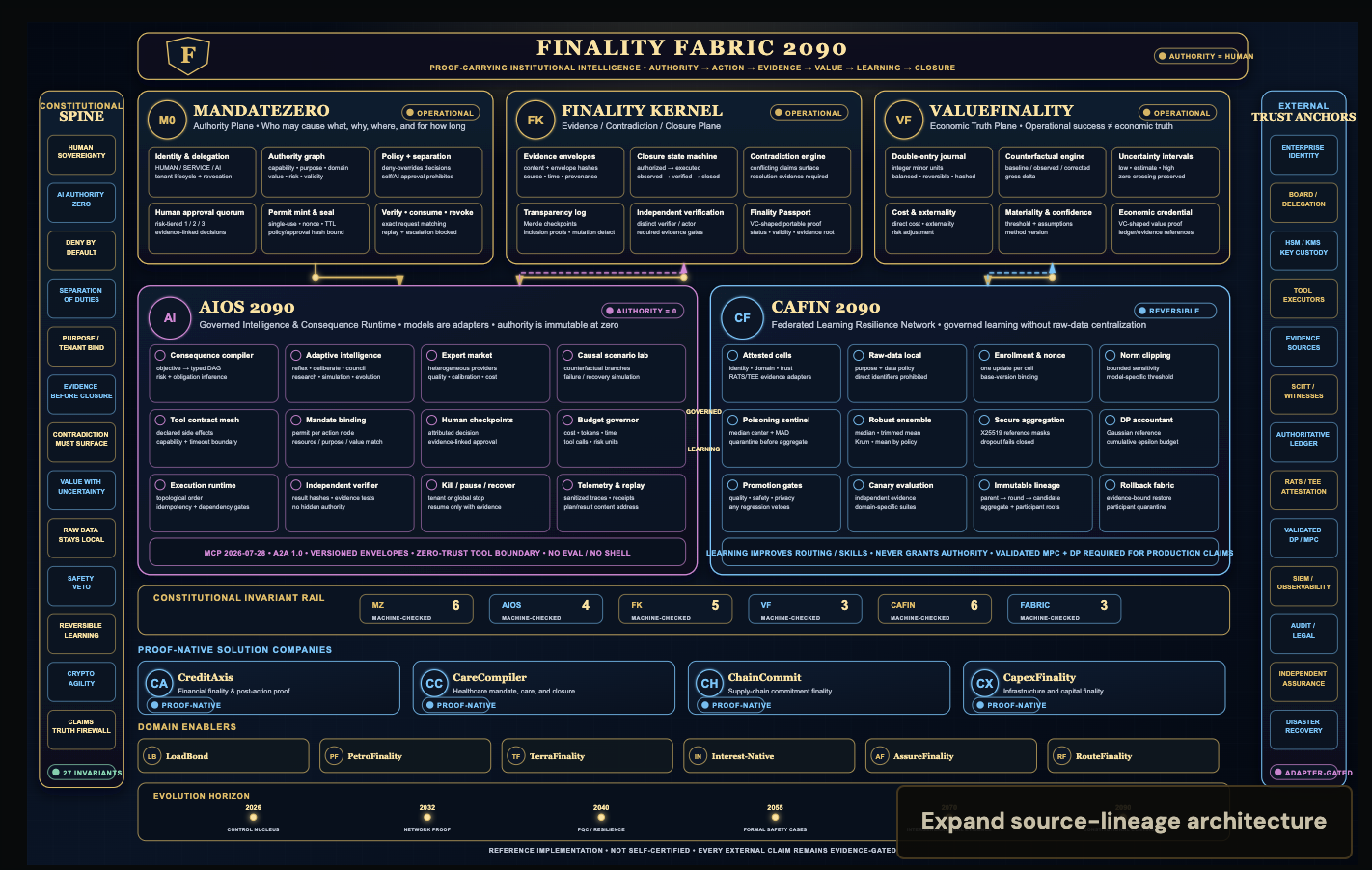
MandateZero
Consumes Experian-approved authority after handoff; validates scope, time and revocation internally. It does not replace Agent Trust or originate authority.
Finality Kernel
Reconciles action evidence with authoritative state, preserves conflicts and controls finality transitions.
ValueFinality
Separates operational success from economic truth and records uncertainty without double counting.
AIOS 2090
Routes tools, experts, checkpoints and recovery under immutable authority; intelligence never grants authority.
CAFIN 2090
Learns from validated outcomes with raw data local, governed promotion gates and reversible models.
Proof-native companies
CreditAxis, CareCompiler, ChainCommit and CapexFinality attach the proof method to defined domains.
BOUNDARY RULE
Experian determines who may act and governs why. MandateZero may validate the approved authority envelope inside Finality after handoff; it does not replace Agent Trust. AIOS and CAFIN may route or learn; neither can create authority or manufacture closure.
10 · CONTROLLED MATERIALS
One indexed record. No serial new proposal.
The immediate SCOPE stays clean while the full $15M → $100M → $15B route is explicit. Proof, integration, transaction, closing and post-sale materials release by named owner and gate from a single controlled record.
Executive Decision Brief
The complete buyer-safe logic: Experian adjacency, falsification, 10× target, data-truth boundary and two-stage route.
Open decision brief ↗Fillable Buyer-Owned SCOPE Protocol
Experian defines workflow, baseline, authoritative state, hidden cases, absolute gates, 10× measures and reviewers.
Open fillable protocol ↗Stage-1 + Control Authorization Memorandum
The full proposed $15M structure, 100% forward credit and separate route to $100M cumulative control—with every diligence and authority gate visible.
Open authorization memorandum ↗Underlying diligence evidence
Counterparty, title, frozen estate, clean build, security, valuation, integration, legal, accounting and signed-decision artifacts.
RELEASE BY NAMED OWNER + GATECONTROLLED DECISION BINDER · SELLER-ORGANIZED INDEX
Download bound decision packetThe full downstream route is already mapped.
Indexing demonstrates process completeness. It does not claim buyer acceptance, diligence completion or authority to release protected content.
Proof
INDEXED · PHASE-GATEDProtocol, frozen estate, adverse cases, clean build, security and measured results
Integration
INDEXED · PHASE-GATEDInterfaces, control ownership, data/privacy boundaries, observability and rollback
Transaction
INDEXED · PHASE-GATEDProtected-access mechanics, consideration architecture and definitive-path controls
Closing
INDEXED · PHASE-GATEDConditions, approvals, verification, delivery and controlled handoff
Post-sale
INDEXED · PHASE-GATEDGovernance, integration sequencing, reporting, continuity and operating controls
Transition
INDEXED · PHASE-GATEDFounder continuity, knowledge transfer, decision rights and successor readiness
BEFORE ANY PROTECTED ACCESS OR FUNDING
Put every independently verifiable, non-secret gate first.
These are conditions to later consideration—not claims that the conditions are already complete.
Counterparty + authority
OPEN UNTIL VERIFIEDSigning entity, decision rights and authorized representatives independently verified.
Title + provenance
OPEN UNTIL VERIFIEDOwnership, contribution chain, licenses and exclusions resolved to buyer satisfaction.
Frozen estate + hashes
OPEN UNTIL VERIFIEDExact evaluation estate, dependency manifest and reproducible cryptographic hashes sealed.
Clean build + security
OPEN UNTIL VERIFIEDQualified third party reproduces the build and records security, privacy and isolation results.
Experian-authored protocol
OPEN UNTIL VERIFIEDWorkflow, interfaces, hidden cases, thresholds, reviewers and stop conditions belong to Experian.
ASSURANCE LADDERE3 → E4 → E5 → E6
Current room claim ceiling: seller-organized E3. E4 buyer protocol, E5 independent assurance and E6 production evidence remain open until the corresponding buyer-controlled records exist.
THE NEXT REVERSIBLE STEPName the two owners.
Confidential discussion material · Non-binding · Subject to counsel · No obligation arises except under duly authorized definitive agreements.
Name the two owners.
Let Experian try to disprove it.
The room now distinguishes four things that cannot be conflated: a complete SCOPE, a mathematically passing result, independently assured evidence and authorized capital. If Finality misses any absolute gate or any buyer-set 10× measure, STOP. If it passes, the same hash-bound record carries the decision into a proposed $15M Stage 1 and, only after separate gates, a $100M cumulative control decision.
01M&A / process
02Product / Strategy
03Architecture / Engineering
04One workflow
05One end state
06One kill test
Public descriptions are used only to frame a proposed complement and Experian-side decision logic. No endorsement or affiliation is implied.